
Host a one-page marketing site
A single-page marketing site doesn't need a full website's worth of hosting infrastructure. Here's how to get one live without over-building the setup.
Updated 2026-08-30
A lot of marketing sites are, functionally, one page: a hero section, some proof points, a pricing or feature breakdown, and a call to action. There's no navigation to speak of beyond scrolling down. That simplicity should extend to hosting, but a one-page site doesn't need the infrastructure a multi-page application would, even though it's easy to default to overbuilding just because "it's a website."
What makes one-page sites easy to host
No routing, no server-side rendering, and usually no backend beyond a form integration or two. The entire site is a single HTML document, plus its CSS, JS, and assets. That means it's static by nature, and a static host is a complete fit for it, not a workaround you're settling for.
Getting it live
Have the page ready as static files, whether hand-coded, exported from a design tool, or output from a simple site builder. Drop the folder onto a browser-based host:
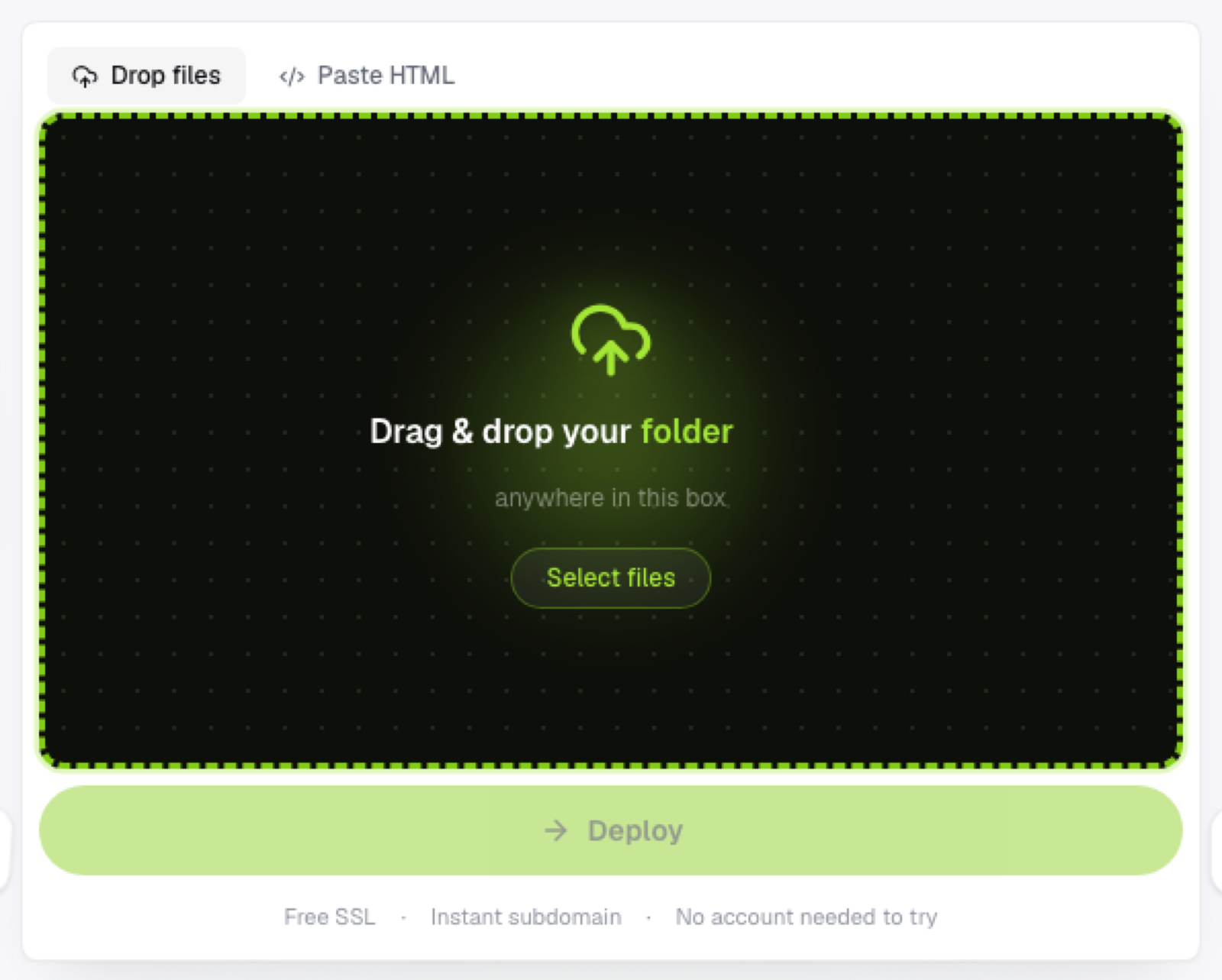
No build step, no server config, it's served exactly as uploaded. Get your HTTPS link immediately, ready to point ads, social posts, or a custom domain at whenever you need to.
Testing variants
One-page marketing sites are often the subject of A/B tests: different headlines, different hero images, different calls to action. Rather than overwriting the same live page every time you want to test a change, deploy each version as a separate variant of the same project. That gives you distinct, shareable links for each version, so you can compare them directly or roll back instantly if a change underperforms once it's live.
Why this doesn't need a "real" website setup
Buying a CMS license, standing up a database, or setting up a build pipeline for a page that's fundamentally static content adds maintenance overhead with no real benefit attached. There's nothing dynamic happening that a database or server-side logic would actually serve. Keep the site as static files, and the hosting stays proportionally simple: drop it in, get a link, done.
When it grows beyond one page
If the marketing site expands into multiple pages, a blog, or anything with more structure, the same hosting approach still works. A folder of files is a folder of files, whether it's one page or fifty, as long as the site stays static and doesn't need anything computed on the server.
Frequently asked questions
Do I need a CMS for a one-page marketing site? Usually not. Editing a static HTML file directly, or rebuilding it from a template and re-uploading, is often faster than maintaining a CMS for content that changes infrequently.
How do I run an A/B test without a testing platform? Deploy two variants of the same project, one per version, and split traffic between them using your ad platform or link-sharing tool rather than server-side logic on the page itself.
Can a one-page site handle a lot of traffic? Static files are inherently well-suited to high traffic, since there's no per-request computation happening, just files being served, which scales more easily than a database-backed page would.