
Free HTML hosting, no credit card required
Host static HTML for free without entering payment details up front. Here's what that actually gets you, and where free tiers usually draw the line.
Updated 2026-08-30
Being asked for a credit card before you've even tried a product is a bad sign for something as simple as hosting a static HTML file. There's no infrastructure cost justification for gating a basic static deploy behind payment info up front. For plain HTML/CSS/JS hosting, "free, no card" should be the default expectation, not a special limited-time offer.
What "free" should actually include
A real HTTPS subdomain, not a watermarked or degraded preview version of what you'd get if you paid. No forced expiration on a reasonably-sized static site, not a 24-hour trial link that quietly disappears. And no card entry just to deploy; payment details should only come up if and when you need something a free tier genuinely doesn't cover, a custom domain, higher usage, team features that go beyond a single person's project.
How this works in practice
Drop a folder, .zip, or pasted HTML directly into the browser:
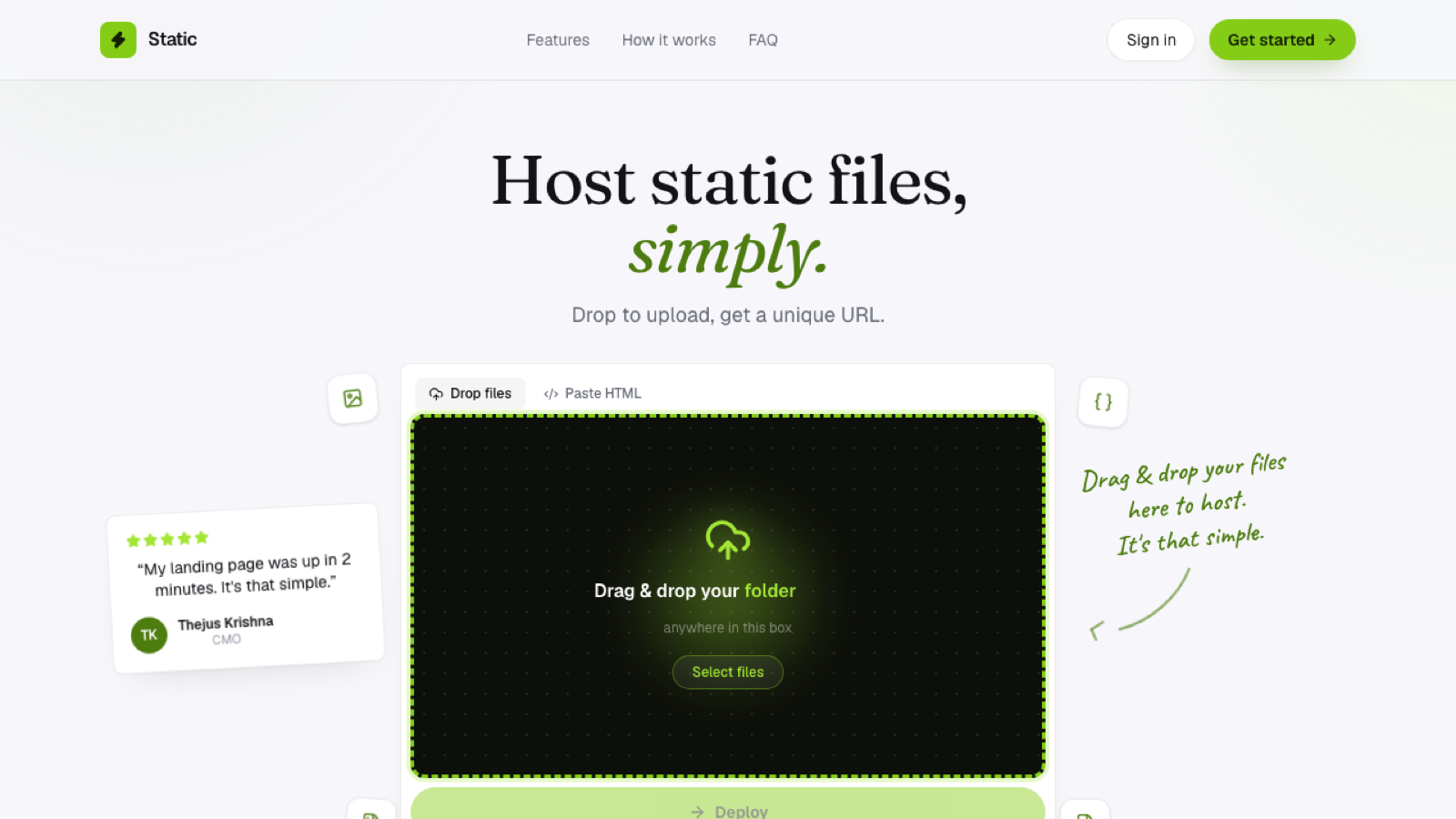
No account needed to see it prepared and ready to go. You're asked to sign up (no card) at the point you actually deploy, and from there you get a live subdomain with HTTPS on by default, no build step, and no watermark stamped across your work.
Where free tiers typically draw the line
Free static hosting is usually genuinely free for the core use case, a subdomain, HTTPS, reasonable static file sizes, because serving static files is cheap to begin with, not a loss-leader requiring a hard upsell. Where hosts across this category start asking for payment is usually custom domains (pointing your own yoursite.com instead of a subdomain), team or collaboration features (multiple people managing the same projects), or high-volume traffic or storage, well beyond what a typical portfolio, landing page, or docs site needs day to day.
None of that should require a credit card just to start using the product. If a host asks for payment details before you've deployed anything at all, that's worth treating as a signal to look elsewhere for a quick static project.
When paying eventually makes sense
Once a project matters enough to need a custom domain or is outgrowing free-tier limits, paying for those specific things is a reasonable trade. The point is that decision should happen once you know the project's worth it, not as a precondition for trying the tool in the first place.
Frequently asked questions
Why do some hosts ask for a card even on a "free" plan? Often to prevent abuse or verify identity; it's worth distinguishing that from actually being charged, though it's reasonable to be cautious about handing over card details for something advertised as free.
Is there a real cost difference for the host between free and paid static hosting? Serving static files is inexpensive at the infrastructure level, so a genuinely free tier for the core workflow is sustainable; the paid tiers usually monetize convenience features rather than the base hosting cost itself.
What should I watch for in a "free" plan's fine print? Storage or bandwidth caps, whether HTTPS is actually included by default, and whether there's a forced expiration on deployed sites are the details most likely to matter later.