
Free subdomain hosting, compared
Free subdomain hosting comes in a few distinct flavors — drag-and-drop, Git-based, and app platforms. Here's how to tell them apart before you pick one.
Updated 2026-08-30
"Free subdomain hosting" covers a wider range of tools than the phrase suggests. The workflow, the kind of content you can host, and how long the link actually sticks around all vary a lot depending on which category you land in. Here's how the category breaks down.
Drag-and-drop static hosts
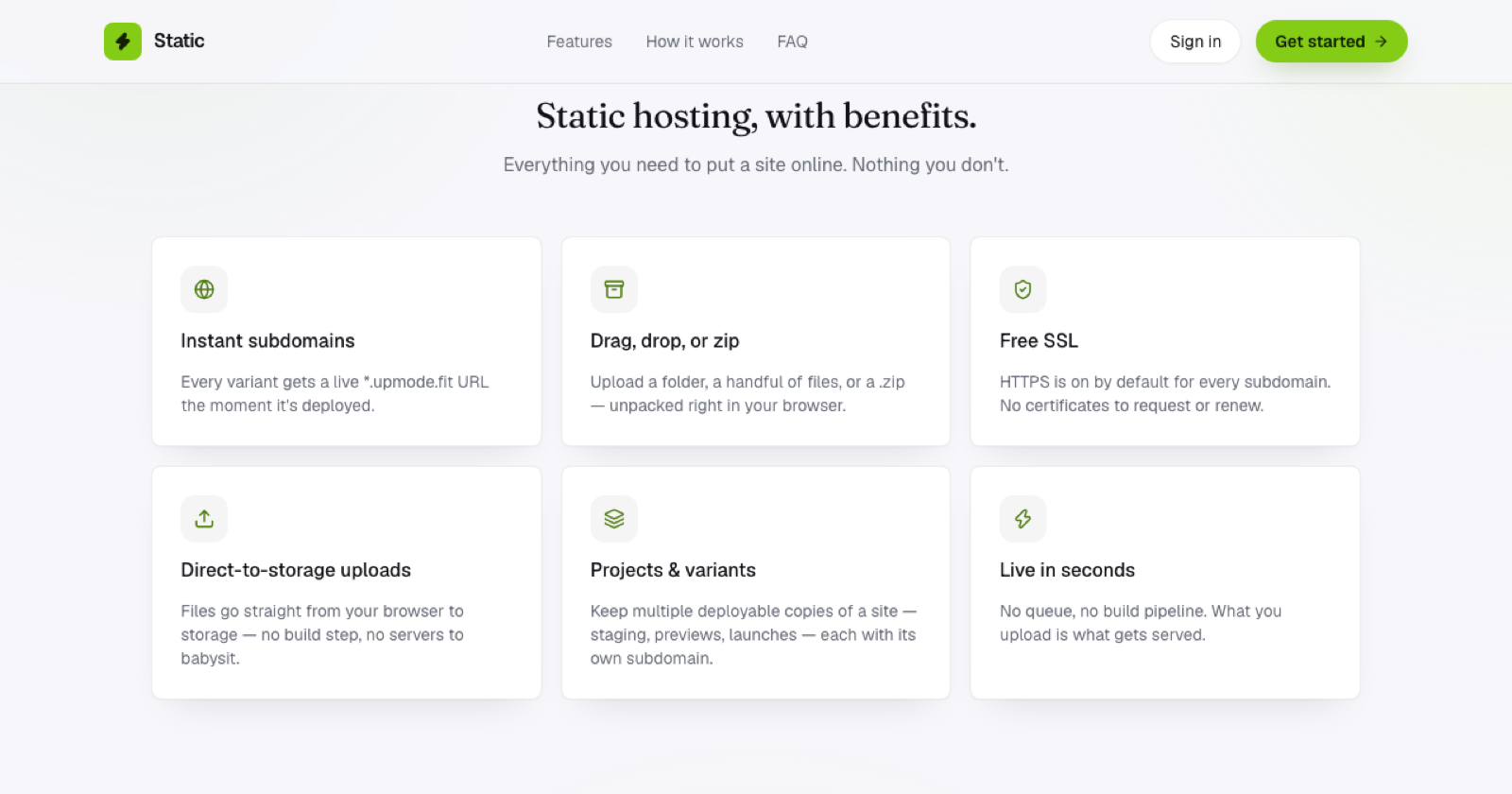
You upload a folder or .zip in the browser and get an instant subdomain back, something like yourname.example.com. No server config, and usually no account required just to try it. This is the fastest option in the category, and the right fit for static HTML/CSS/JS sites: portfolios, landing pages, docs, client previews.
Flaash works this way specifically. Drop a folder or .zip, get a *.flaash.live subdomain live immediately, free SSL on by default, no build step:
Git-based platforms
Netlify, Vercel, and Cloudflare Pages also hand out a free subdomain, but it arrives as a side effect of connecting a Git repository and running a build, not as the point of entry. That's a great fit if you're already framework-based and want CI/CD included. It's more setup than a plain static folder actually needs.
App-hosting platforms
Services built around running full applications, not just static files, also give out free subdomains, but they assume you're deploying a running server process, not a folder of finished files. That's overkill if your project has no backend at all.
The details that actually matter
When comparing subdomain hosts, look past "is it free" and check these instead:
- Do you control the subdomain name, or is it a random generated string?
- Is HTTPS automatic, or a manual (sometimes paid) step?
- Can you keep updating the same subdomain, or does every deploy spawn a disconnected new one?
- Is there a build step, or does it serve exactly what you upload, as-is?
Picking one
If your project is plain static files and you want the least friction between "this is ready" and "here's the link," a browser-based drag-and-drop host is the shortest path: no Git, no build, no server. Reach for a Git-based platform once your project actually has a build step worth automating on every push.
Frequently asked questions
Do free subdomains expire? It depends entirely on the host. Drag-and-drop hosts built around persistent projects (rather than disposable previews) generally keep a subdomain live as long as the project exists; disposable-preview tools may not.
Can I use a free subdomain for a real, ongoing project, not just a test? Yes, plenty of production portfolios, landing pages, and small businesses run entirely on a subdomain. It's a real address, not a placeholder, it's just not one you personally own the way a purchased domain is.
Is there a downside to picking a memorable subdomain name early? Not really, beyond making sure it's actually available. A clear, recognizable subdomain is easier to share and remember than a randomly generated one, and there's no cost difference between the two.